Overview
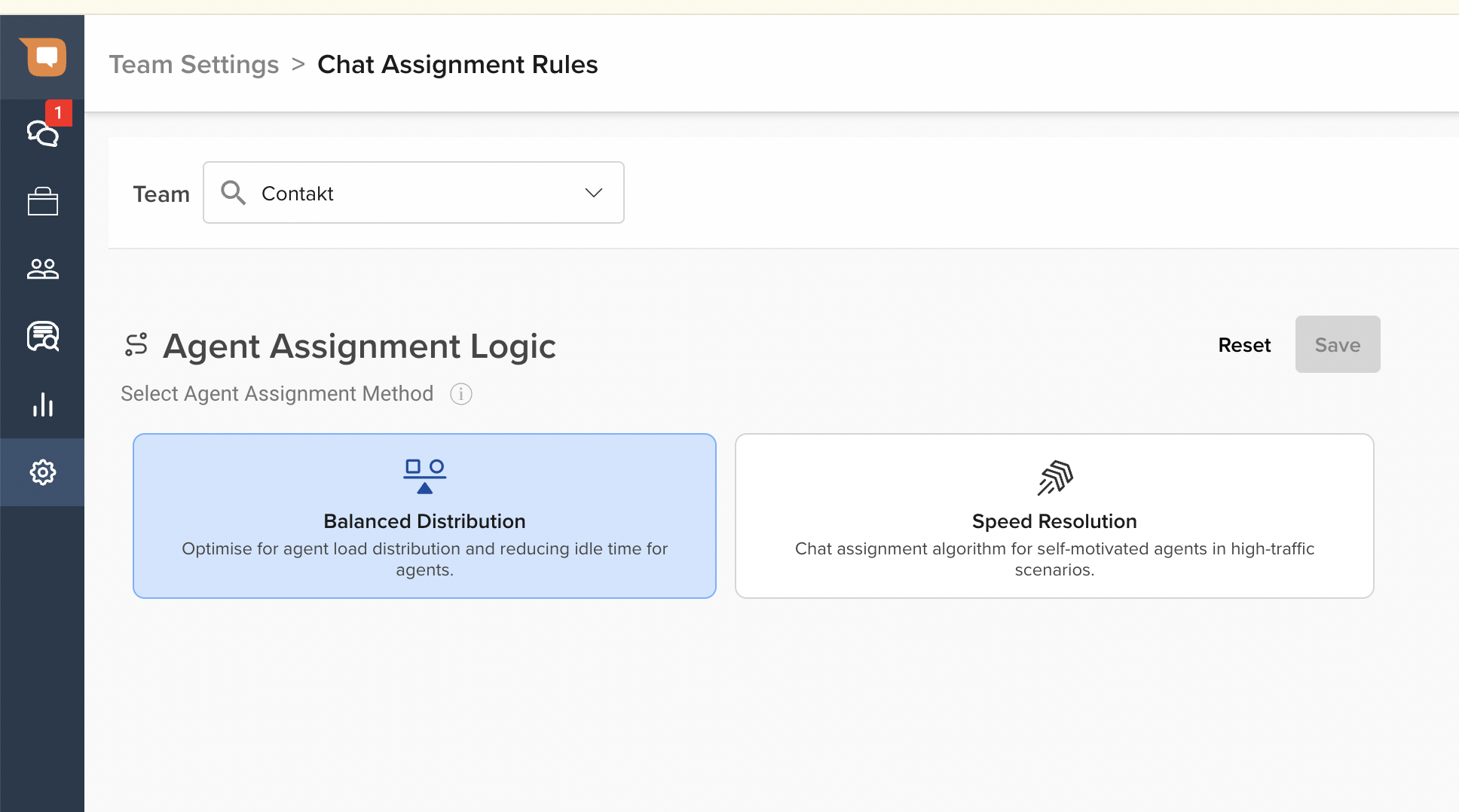
When a chat reaches the Smart Agent Chat tool, a team gets assigned to the user. After reaching the team, an agent receives the chat. Agent Assignment Logic helps you to choose different modes in which the agents will receive the chats. These algorithms cater to various business demands and team settings.
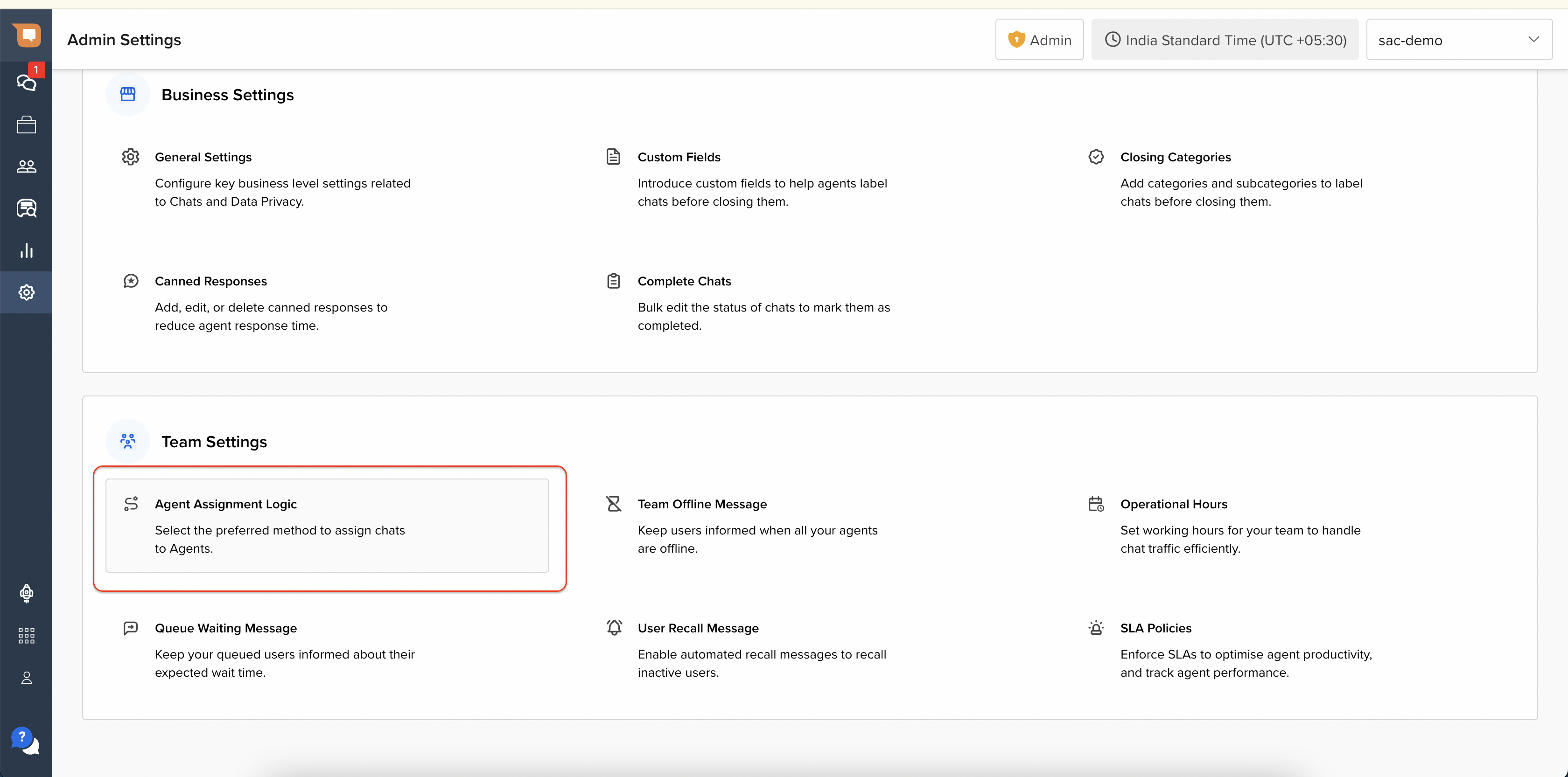
To access this setting, go to Admin Settings and then to Agent Assignment Logic:
Key Terms
Let’s understand certain terminologies:
- Agent Concurrency: The number of chats that an agent can take at any given time. We also call concurrency as the maximum number of chats an agent gets pinned on the MyChats space
- Empty Slot: Number of chats that can be pinned to an agent at a given time. Say the concurrency for agents is 3 but the agent has only 1 active chat, this means the number of empty slots with an agent is 2.
- Team Queue: When users are waiting for their chats to get assigned to an agent, they are waiting in a pending or queue state.
- Idle Time: This Idle time duration is determined by the time elapsed since the agent received the last chat.
- Agent status: Agents can be online meaning they can receive chats. And when agents go offline, they would not get fresh / newer chats but they can get user chats wherein they had a conversation earlier or from their own queue. After logging out, all chats from the agent queue, which were pinned to the agent are moved to the team queue, and chats that were in waiting for user state, are marked as complete (If the user returns, it is taken up as a new chat.)
Choosing an Agent Assignment Logic
Our clients have the flexibility to choose between two agent assignment algorithms as seen above:
A. Balanced Distribution
This accounts for Agent Concurrency, Empty Slots, and Idle Time. Chat gets assigned as soon as an agent slot is available i.e. has empty slots (and the agent is online)
- It’s Great for: Even chat load distribution among agents and reducing average agent’s idle time to ensure that agents waiting for a long time get the chat first.
- In case a chat was allocated to an agent, and the agent loses network connection. If the loss of network persists for more than 5 minutes, we move chats back into the team queue, so that another online agent can receive the chat.
- Chats that are in the pending state get completed when the last agent of a team logouts.
- While following Balanced Distribution, the individual concurrency of an agent will be considered, regardless of how many Teams the Agent is a part of. If an Agent's concurrency is blocked due to a chat in Team A, and the Agent is also a part of Team B, then the Agen't concurrency will be blocked for Team B as well (and vice versa).
Note: We encourage Supervisors to be thoughtful about allocating Agent concurrency for shared agents. While keeping a higher concurrency can allow Agents to handle more chats per Team, it could negatively impact the quality of issue resolution.
- Optimized for: Chat load as it’s almost evenly distributed across online agents at the time.
- Con(s): Unlike Speed Resolution, high-performing agents may not be best utilized.
Note: Clients for whom efficiency in distribution is important should choose this chat algorithm.
B. Speedy Resolution
The fastest agents get more chats. Every time an agent closes a chat or intermittently every 10 seconds, the agent requests a new chat from the queue.
- Great for: Highly-motivated agent workforce i.e. Fastest agents end up getting maximum chats
- Optimized for: Agent speed and high chat volume scenarios
- Chats that are in the pending state get completed if team settings ("Mark chat as complete when no agents online ? ") are enabled, else they remain in pending state.
- Con(s): Chat load is not balanced across agents i.e., fast agents are the ones who close chats quickly thus making the call to request for chats frequently. This breaks the 10 seconds cycle and creates an uneven distribution of chats.
Note
- If there is a single client and multiple businesses set up, all businesses must use the same algorithm.
- If there are multiple clients, no compulsion of using the same algorithm. One can select different algorithms for each.
- An agent can only follow a single chat distribution algorithm, ie, we do not support Agent A being part of Team A (balanced distribution) and Team B (speed resolution).