Let us first understand what a KMS is. KMS stands for Knowledge Management System. It is a tool that businesses use to help organize their documentation, or in other words Knowledge Base, which includes documents related to their business-specific use cases, frequently asked questions, and other information. These documents are stored in easily accessible formats for internal and external users.
The USU predictive knowledge management solutions take a holistic view of your service to establish intelligent knowledge management across all departments, functions, and communication channels. This lets you reach your service KPIs more efficiently and increase overall satisfaction.
How does USU (Unimyra) Knowledge Management Integration with Haptik help the users?
Once this integration is enabled, every time a user asks a query on your bot, the bot will respond by suggesting relevant articles from your Knowledge Base on USU Knowledge Management Software, after understanding the query's intent. We will understand this in detail, in the further sections of this article.
Prerequisites for integrating USU (Unimyra) Knowledge Management with Haptik
- A paid account on USU (Unymira). You can read more about it here.
- A Knowledge Base on USU (Unymira). You can learn more about it here.
- A bot on Haptik. You can learn more about creating a bot here.
How to set up?
Once you have all the prerequisites ready with you, all you need to do is integrate your USU (Unymira) Knowledge Management with Haptik. For connecting them, you would need to add integration details to the Platform Deployments section on Haptik.
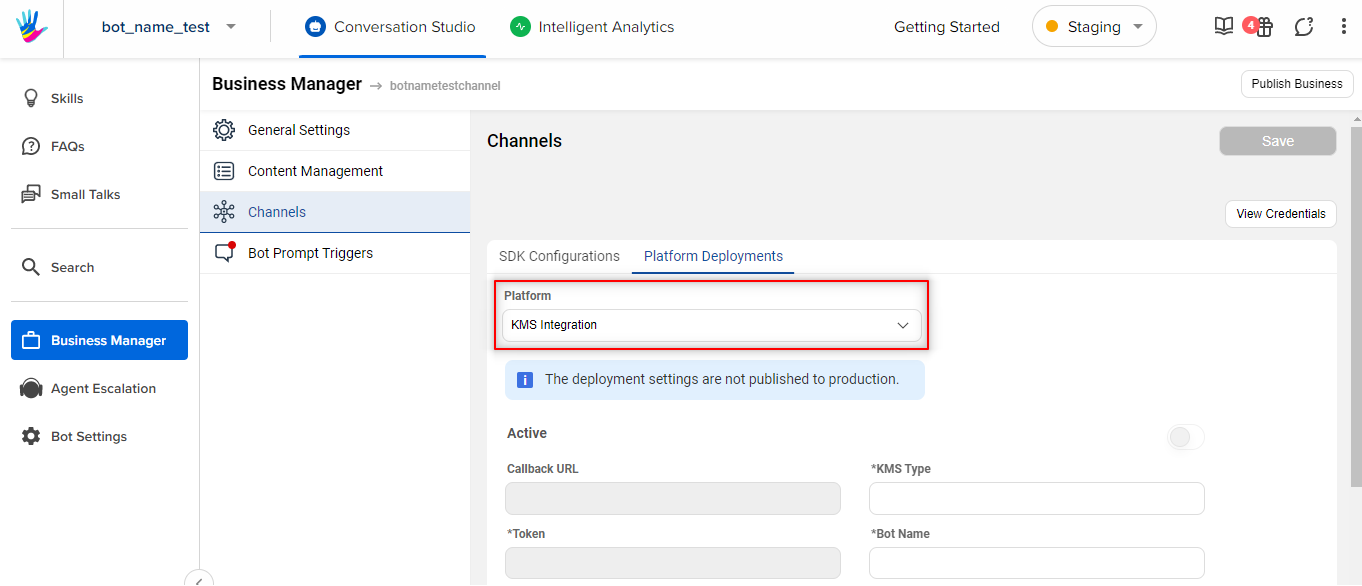
Step 1: Log in to Haptik, open your bot and navigate to Conversation Studio > Business Manager > Channels > Platform Deployments, and select KMS Integration from the Platform dropdown, as shown.
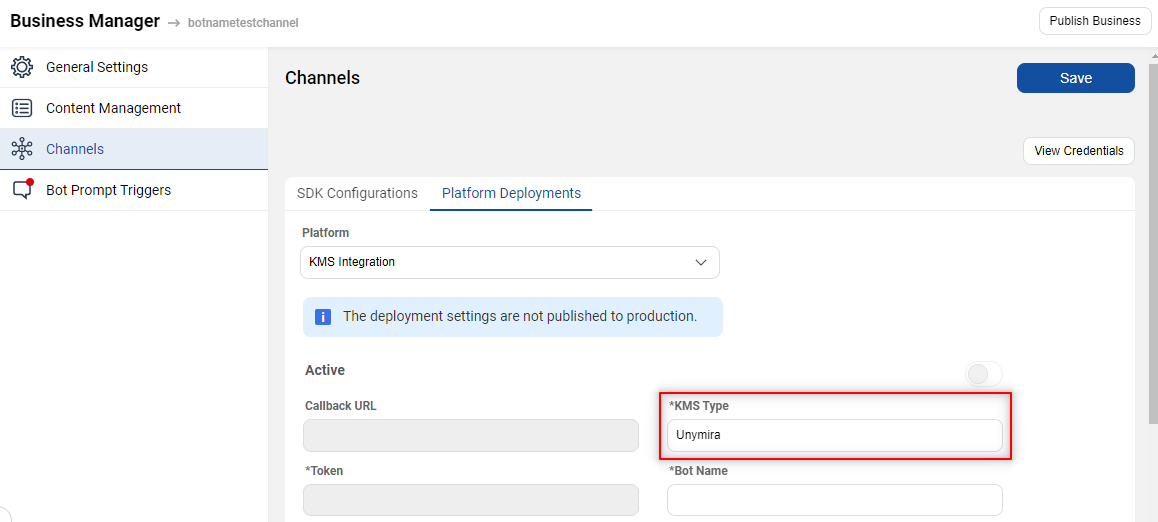
Step 2: Add Unymira in the field KMS Type.
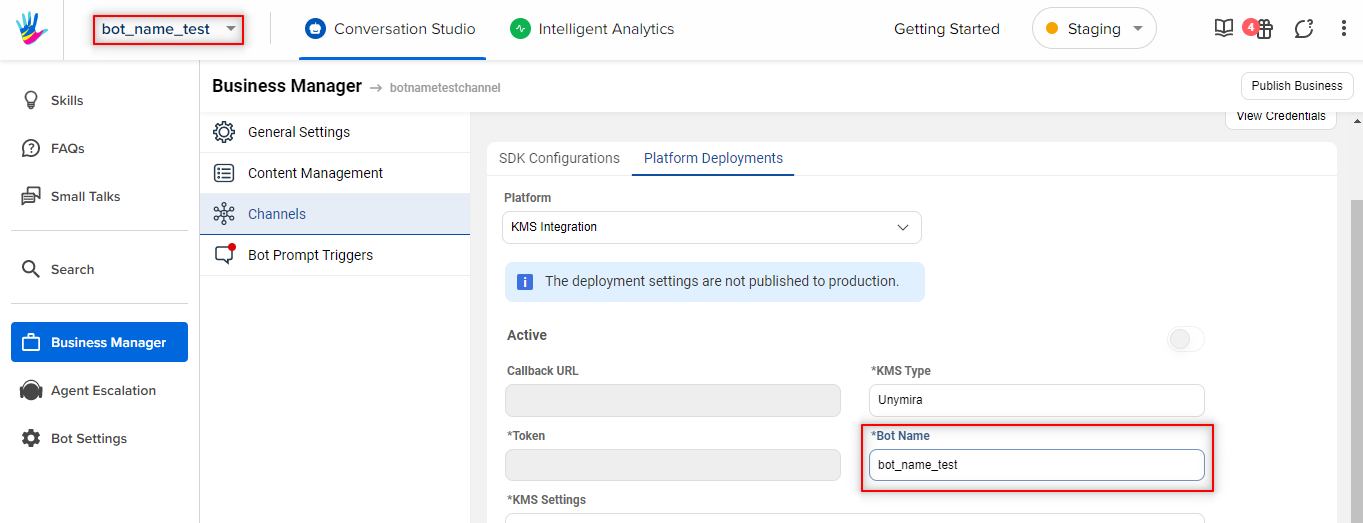
Step 3: Add your bot's name in the field Bot Name. Make sure you have added the name accurately.
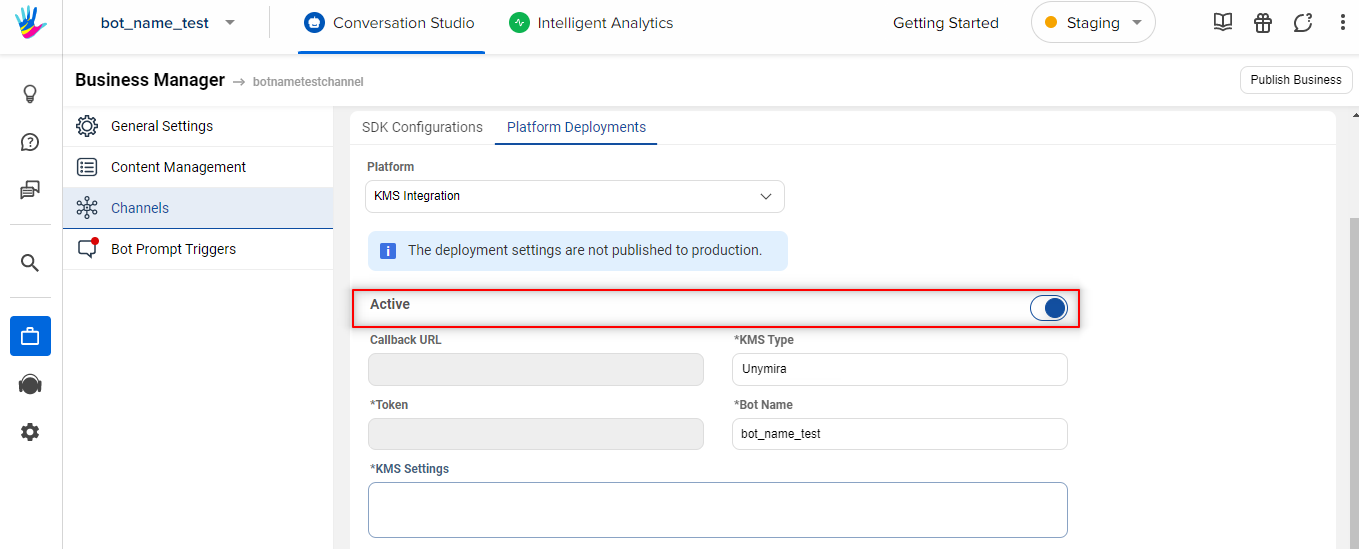
Step 4: Turn the Active toggle button on.
Step 5: Under KMS Settings, enter the following JSON as per the instructions.
{
  "api_key": "<paste your API key here>",
  "unymira_domain": "https://<your_subdomain_name>.usu.com",
  "default_thumbnail": "https://haptikappimg.haptikapi.com/kms.png"
}
💡For api_key and unymira_domain, please connect with the Unymira SPOC.
default_thumbnail will be the thumbnail URL, that will be used in the carousel when the bot will display the articles.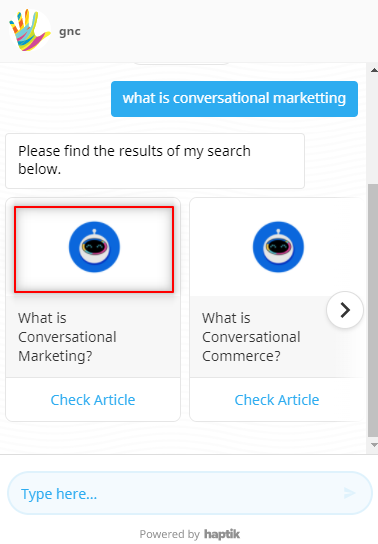
Once you have the api_key and unymira_domain, update the JSON under KMS Settings.
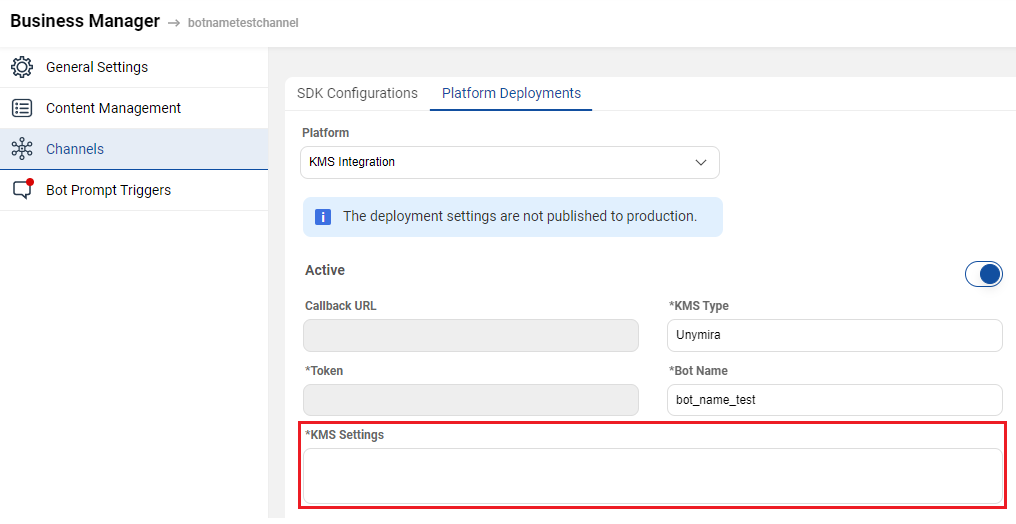
Step 6: Once you have populated all the fields in the Platform Deployments, with the appropriate details in it, you can Save it.
Step 7: You will have to raise a Support Ticket on the Haptik portal or drop an email at support@haptik.ai, for activating the KMS feature on your bot. Please mention your bot's name on the ticket. This is a one-time activity, and it will take at the most 1-2 business days for activating this feature.
Note: Haptik syncs articles from your Knowledge Management System every 24 hours at midnight, to ensure that the bot is up-to-date with the latest content changes.
Once the Knowledge Management integration is activated on your bot, you are good to test your bot and see how it fetches the articles from your Knowledge Base added on the USU (Unymira).
Once tested, you can move your bot to the Production Environment, where you can take it LIVE for your users. Congratulations!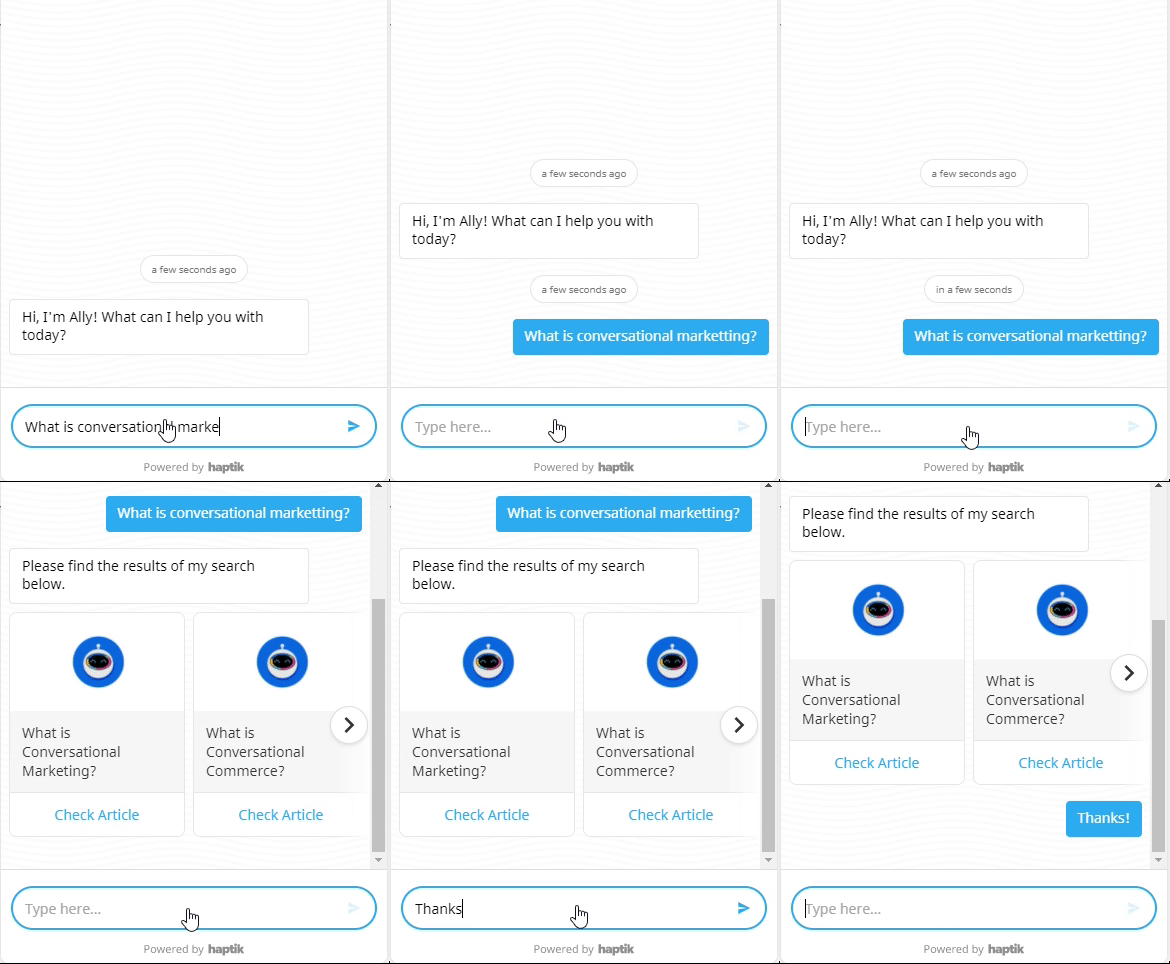
Note:
The bot will suggest Knowledge Base articles in the following order of prioritization
Steps in the bot > FAQs added > Knowledge Management System
What this means is, that if a user asks a query to the bot, and if there is a Step present in the bot for handling that query, the bot will fetch the response from that Step. If there is an FAQ added in the bot, then the bot will fetch the response to the user's query from the FAQs.
If none of the two mentioned above are present, that is when the bot will fetch the response from the Knowledge Management System and will suggest appropriate articles as a response.